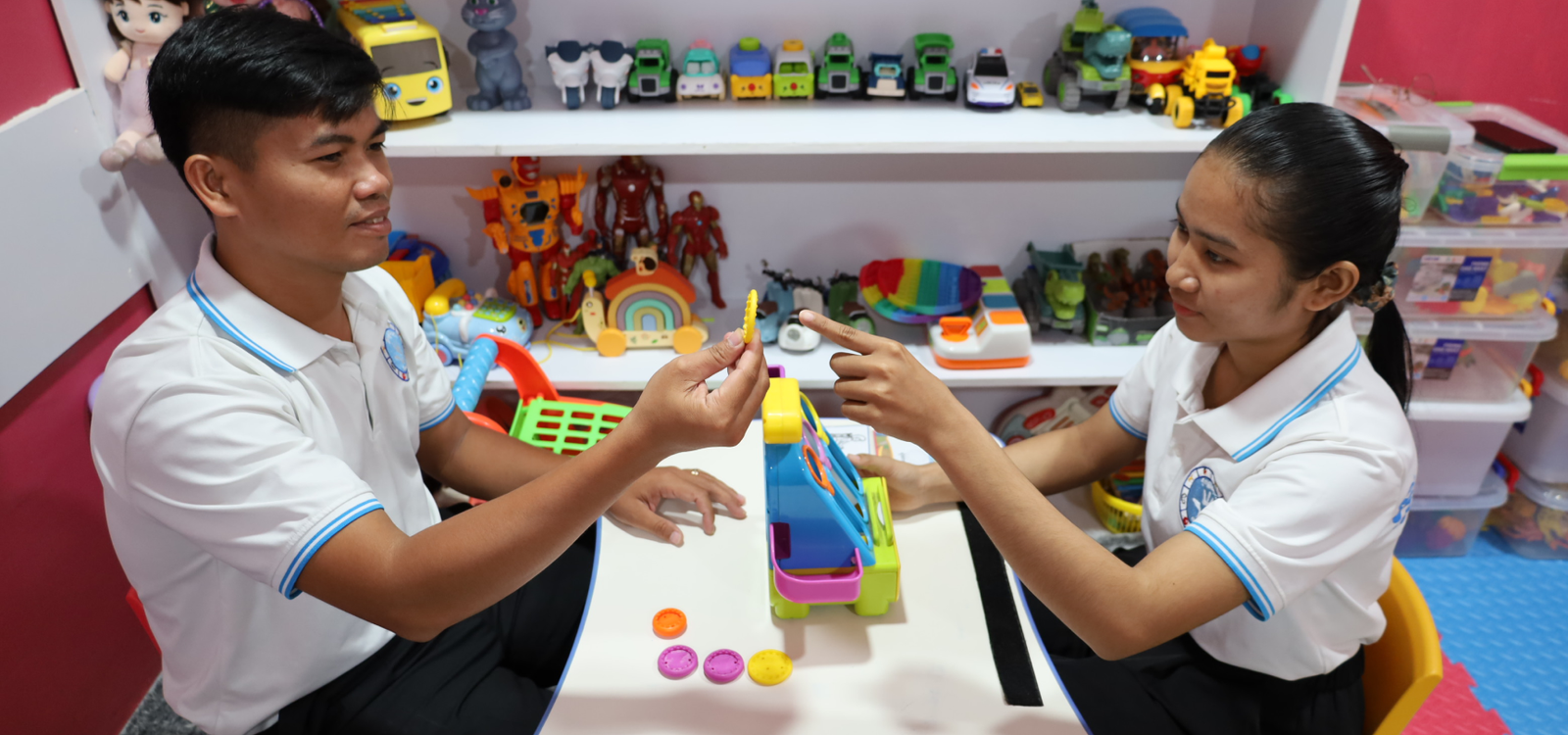
Special Education Program
Hope Kids provides affordable, inclusive, and professional education for children with autism and special needs in Phnom Penh and across Cambodia.
Special Education Program
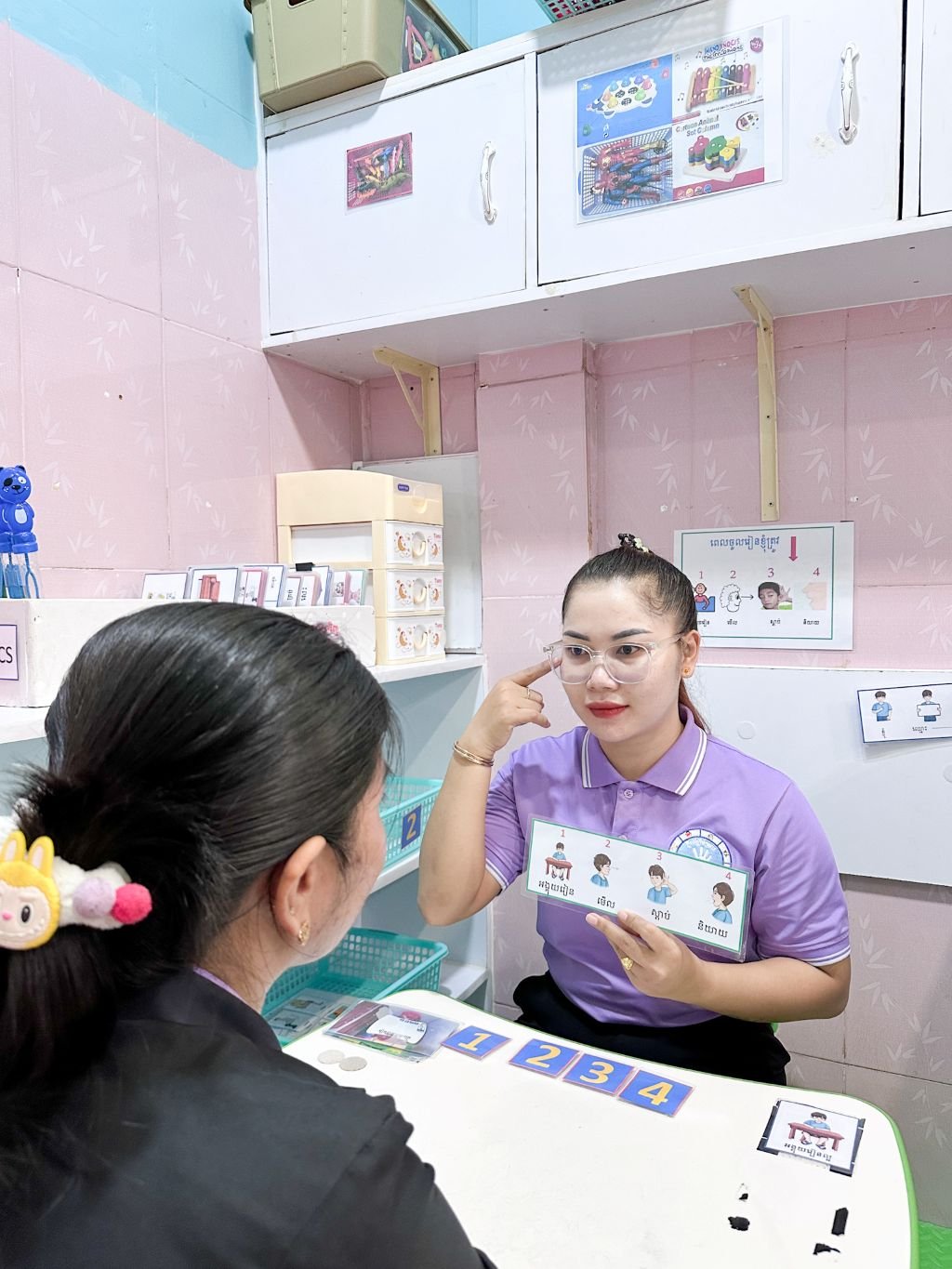
Individualized Special Education at Hope Kids Special Education School in Phnom Penh, Cambodia.
Program provides individualized educational support for children with developmental, learning, communication, behavioral, and other educational needs.
Special education is more than adapting academic lessons. It considers the whole child and aims to help children access learning, develop functional skills, communicate,
participate, and become increasingly independent. Each child's educational program is developed around their current abilities, strengths, developmental needs, learning profile, interests, and individual goals
What Is Special Education?
A child's needs may be addressed by adapting:
- ● The curriculum and learning objectives
- ● Teaching methods and materials
- ● The pace and amount of instruction
- ● The learning environment
- ● Communication systems
- ● Classroom routines and expectations
- ● The level and type of adult support
- Special education may support both academic and functional development.
Depending on the child, educational goals may include:
- ● Academic and pre-academic skills
- ● Communication and language
- ● Social interaction
- ● Attention and learning readiness
- ● Emotional regulation
- ● Behavior and self-regulation
- ● Fine- and gross-motor development
- ● Daily living and self-care skills
- ● Independence
- ● School readiness
The purpose is not to make every child learn in the same way. The purpose is to provide the support and adaptations that allow each child to learn and participate as successfully as possible.
Who Can Benefit from Special Education?
Special education is not limited to a particular diagnosis. A child may benefit when developmental, learning, communication, behavioral, physical, or other needs are affecting their ability to access education and participate successfully.
This may include children with:

Autism Spectrum Condition (ASC)

ADHD

Intellectual or developmental disabilities

Global developmental delay

Specific learning difficulties

Speech and language difficulties

Cerebral palsy or other physical disabilities

Communication difficulties

Behavioral or emotional regulation difficulties

Multiple or complex support needs
Two children with the same diagnosis may have very different educational needs. For this reason, educational planning should be based on the individual child rather than diagnosis alone.
What Skills Can Special Education Support?
Special education can address a broad range of skills depending on the child's needs.
Academic & Learning Skills
Early literacy, writing, numeracy, problem-solving, attention, and task completion.
- • Early literacy and reading
- • Writing and pre-writing
- • Numeracy and mathematical concepts
- • Following instructions & problem-solving
- • Attention, concentration & readiness
Communication Skills
Expressing needs, receptive understanding, vocabulary, and AAC implementation.
- • Understanding instructions
- • Expressing wants and needs
- • Vocabulary and functional language
- • Social communication
- • Alternative & Augmentative Communication (AAC)
Social & Emotional Skills
Turn-taking, cooperative play, emotional regulation, and group participation.
- • Social interaction & turn-taking
- • Sharing and cooperative play
- • Emotional awareness & regulation
- • Coping strategies & flexible participation
- • Classroom and group participation
Independence & Daily Living
Self-care, dressing, eating, toileting, hygiene, organization, and safety skills.
- • Dressing, eating & toileting
- • Personal hygiene & clean up
- • Following daily routines & organizing belongings
- • Making choices & completing tasks independently
- • Community and safety skills
For some children, these functional skills may be just as important as traditional academic goals because they directly affect participation and independence in everyday life.
What Does Individualized Education Look Like in Practice?
Individualization is not just handing out different worksheets. It is an active problem-solving cycle when a child experiences difficulty:
What can the child do now?
What do they need to learn next?
What is making learning difficult?
What support or adaptation will help?
How will we know they are progressing?
What can the child do now?
What do they need to learn next?
What support or adaptation will help?
What is making learning difficult?
How will we know they are progressing?
For example, if a child has difficulty completing a classroom activity, the solution might involve:
- ● Breaking the activity into smaller steps
- ● Using visual instructions
- ● Modifying the materials
- ● Providing additional processing time
- ● Teaching a prerequisite skill
- ● Using modelling or prompting
- ● Changing the learning environment
- ● Providing an alternative way to communicate
- ● Gradually reducing adult assistance as independence develops
The strategy should be selected according to why the child is experiencing difficulty and what will help them participate more successfully.
How Is Special Education Different from Traditional Education?
Special education adapts educational content, instruction, environment,
The important question is not only:
- “Can the child complete the task in the traditional way?”
- It is also:
- “What does the child need in order to demonstrate what they know and
- participate meaningfully?”
What Are the Benefits of Individualized Special Education?
The benefits will vary from child to child because goals are individualized. Depending on their needs, children may develop:
Greater Academic Learning
Developing literacy, numeracy, and cognitive skills at an appropriate individual pace.
Improved Communication
Gaining reliable ways to express thoughts, understand directions, and engage with others.
Active Classroom Participation
Engaging meaningfully in classroom routines, group lessons, cooperative play, and peer activities.
Increased Independence
Completing routines, managing belongings, and solving problems with systematically reduced adult help.
Stronger School Readiness
Building attention, emotional regulation, transitions, and social skills required for educational settings.
Increased Confidence & Joy
Experiencing consistent success with appropriate challenges builds pride and a love for learning.
Does Special Education Only Focus on Academic Skills?
A balanced educational program considers both:
“What does this child need to learn?”
and
“What does this child need to participate more independently in everyday life?”
This is particularly important for children with significant developmental or communication needs, where functional and adaptive skills may be central to their educational program.
How Hope Kids Delivers Special Education
Our multidisciplinary model combines structured instruction with therapeutic integration and deep family partnership:
Individualized Learning Goals
Custom Individualized Education Plans (IEPs) targeting high-priority academic and functional areas.
Structured & Predictable Learning
Using visual schedules, organized workstations, and clear environmental cues to support learning.
Individual & Small-Group Instruction
Balancing 1:1 focused instruction with small-group activities to build social communication.
Objective Progress Monitoring
Regular data collection, observation, and work sample reviews to systematically update teaching plans.
Multidisciplinary Collaboration
Coordinating special education with Speech Therapy, Occupational Therapy, Physiotherapy, and ABA.
Does My Child Need a Diagnosis to Receive Special Education?
An educational or developmental assessment can help identify the child's current strengths, areas of difficulty, and the types of support that may be appropriate.
A diagnosis may be important for some children and families, but it is not the only factor considered when planning educational support.
How Is Progress Measured?
Depending on the skill, progress may be measured by looking at:
- ● Whether the child can complete a task
- ● How accurately they perform a skill
- ● How much prompting or assistance they require
- ● How consistently they use the skill
- ● Whether they can use the skill in different settings
- ● Whether the skill is maintained over time
For example, instead of simply recording that a child has “improved independence,” a team might monitor whether the child can complete a five-step classroom routine independently with fewer prompts.
This allows educators and therapists to understand whether an intervention is working and whether goals or teaching strategies need to be adjusted.
Frequently Asked Questions
Why Choose Special Education at Hope Kids?
At Hope Kids, we believe effective special education begins with understanding the individual child.
Our approach combines individualized educational planning, structured teaching, functional learning, progress monitoring, and collaboration across education and therapy services.
Our aim is to help children develop skills that are meaningful not only inside the classroom, but also across home, school, and community environments.
The focus is on helping each child learn, communicate, participate, develop independence, and make meaningful progress according to their individual abilities and goals.
Contact Hope Kids
If you would like to learn more about special education in Phnom Penh and Cambodia, contact Hope Kids Special Education School to discuss your child's individual learning and developmental needs. Our team can help you understand the available educational and support options and determine which type of program may be appropriate for your child.