Choosing a school can be one of the biggest decisions parents make after their child is identified as autistic.
Parents may ask:
“Does my child need a special school?”
“Can my child learn in a mainstream classroom?”
“What kind of support does an autistic child need?”
There is no single answer.
The right educational environment depends on the individual child's strengths, learning profile, communication, independence, sensory needs, behavior, social development and support requirements.
An autism-friendly educational environment is not simply a classroom where autistic children are present.
It is an environment that adapts teaching and support so children can participate and learn effectively.
What Might an Autistic Child Need at School?
Support may involve:
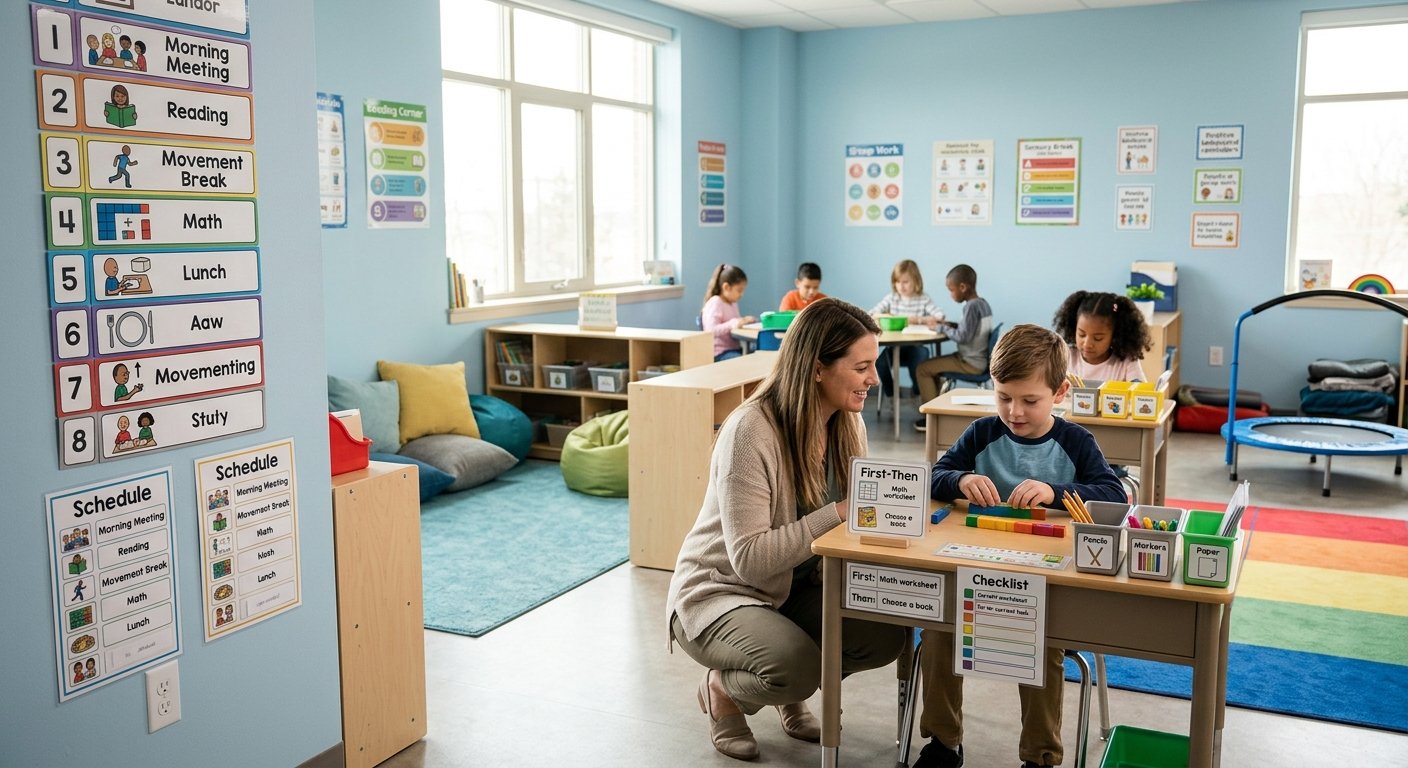
- Predictable routines
- Visual schedules
- Clear instructions
- Individualized learning goals
- Communication support
- AAC
- Sensory accommodations
- Structured learning environments
- Opportunities for social interaction
- Support for emotional regulation
- Daily living skills
- Functional independence
- Appropriate behavioral support
Not every child needs all of these.
Why Predictability Can Help
Some autistic children find unexpected changes difficult.
A visual schedule can show:
Arrival → Morning activity → Break → Learning → Lunch → Outdoor play → Home
This makes the sequence of activities more predictable.
TEACCH describes visual schedules and structured teaching as ways of making routines and expectations more understandable and supporting independence.
The AAP also identifies predictable routines and visual activity schedules as common features of structured, empirically supported intervention environments for autistic children.
What Is Structured Teaching?
Structured Teaching is strongly associated with the TEACCH approach.
It may involve:
- Physical organization of the environment
- Individualized schedules
- Work systems
- Visual supports
- Clear activity sequences
- Organized workspaces
The purpose is not to make every child behave in exactly the same way.
It is to make the learning environment easier to understand.
What About Communication?
A child does not need fluent speech to participate in education.
Communication support may include:
- Gestures
- Pictures
- Signs
- AAC
- Speech
- Visual instructions
A child's communication system should allow them to:
- Request
- Refuse
- Ask for help
- Make choices
- Comment
- Answer
- Participate socially
Communication is essential to learning and participation.
What About Sensory Needs?
Some children may struggle with:
- Noise
- Bright lights
- Crowded spaces
- Touch
- Clothing
- Movement
- Smells
- Certain classroom materials
An autism-friendly environment can consider whether the physical environment is creating unnecessary barriers.
This does not mean removing every sensory challenge.
It means understanding what affects the child's ability to participate and making reasonable, individualized adjustments.
What About Behavior?
Behavior should be understood in context.
Instead of asking only:
“How do we stop this behavior?”
A team can ask:
“What is the child communicating?”
“What happens before the behavior?”
“What happens afterwards?”
“Is the child overwhelmed?”
“Is communication difficult?”
“Is the task too difficult?”
“Has the routine changed?”
The AAP recommends functional assessment and individualized intervention when behaviors interfere with functional skills.
What Does Individualized Education Mean?
Two autistic children in the same classroom may have completely different educational goals.
For one child:
Recognize letters and numbers.
For another:
Follow a two-step classroom routine.
For another:
Communicate choices using AAC.
For another:
Complete a toileting routine with reduced assistance.
For another:
Participate in cooperative play.
Individualized education means that teaching responds to the child's current skills and meaningful next steps.
Should School Goals Only Be Academic?
No.
Academic learning is important, but education for children with developmental needs may also include:
- Communication
- Social participation
- Emotional regulation
- Daily living skills
- Motor skills
- Independence
- School readiness
- Functional learning
The AAP identifies functional independence and adaptive skills as important intervention goals for autistic children.
How Can Parents and Teachers Work Together?
The strongest plans do not exist only inside the classroom.
Parents and teachers can share information about:
- What motivates the child
- Communication methods
- Successful strategies
- Difficult routines
- Sensory needs
- Independence goals
- Emerging skills
- Changes in behavior
Skills are more likely to become useful when children can use them across different environments.
Does Every Autistic Child Need a Special Education School?
No.
Some children thrive in mainstream classrooms with appropriate support.
Others benefit from specialized educational environments.
The decision should consider the child's individual needs rather than assuming that one setting is appropriate for every autistic child.
How Hope Kids Can Help
Hope Kids Special Education School provides individualized educational and developmental support for children with autism and other developmental needs.
Programs may incorporate structured teaching, visual supports, communication support, special education, speech and language therapy, occupational therapy, behavioral support, school readiness and daily living skills.
The focus is on helping children participate, learn and develop meaningful independence in ways that reflect their individual profiles.